Choosing a platform is one of the most important decisions in any website project, and one of the hardest to reverse. Pick well and your site is easy to update, fast and ready to grow. Pick badly and you face slow pages, rising costs or a rebuild within a few years.
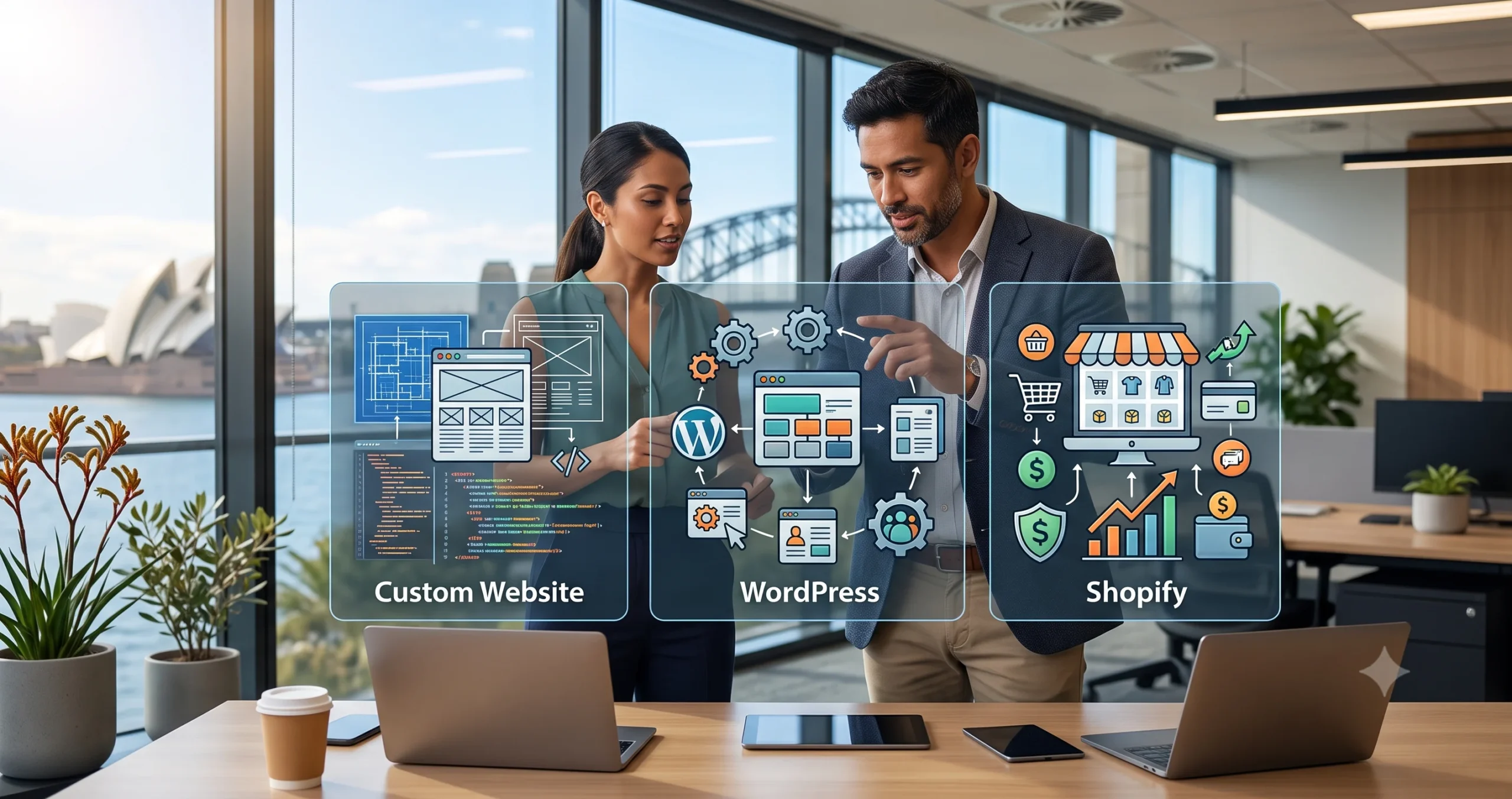
For most Sydney businesses, the choice comes down to three options: a custom-built website, WordPress or Shopify. This guide explains what each one is, where each performs best, what they really cost to run, and the questions to ask a development partner before you commit. By the end, you’ll know which option fits your business and how to choose the right team to build it.
Quick Answer: Which Is Better, a Custom Website, WordPress or Shopify?
WordPress is the best fit for most content-led and service business websites that need flexibility at a sensible cost. Shopify is usually the best choice for online stores that want reliable ecommerce with less technical upkeep. A custom website makes sense when you need unique functionality, complex integrations or a platform that off-the-shelf tools can’t provide.
Key takeaways:
- Choose the platform based on your business model, not the developer’s preference.
- WordPress offers flexibility; Shopify offers simplicity for ecommerce.
- Custom builds suit unique requirements but cost more to build and maintain.
- Compare total cost of ownership over three years, not just the build price.
What Each Option Actually Is
A custom website is built from the ground up by developers using programming frameworks, designed around your exact requirements. You get full control over features and design, but you depend on developers for most changes.
WordPress is an open-source content management system and the most widely used CMS on the web. You host it yourself or with a hosting provider, extend it with themes and plugins, and your team can update content without coding.
Shopify is a hosted ecommerce platform. You pay a monthly subscription, and Shopify handles hosting, security and checkout, while themes and apps add design options and features.
Side-by-Side Comparison
| Option | Best For | Main Trade-Off |
| Custom website | Unique functionality, complex integrations, web applications | Higher build and maintenance costs; reliance on developers |
| WordPress | Service businesses, content-heavy sites, flexible marketing sites | Needs ongoing updates, security care and quality hosting |
| Shopify | Online stores of most sizes | Monthly fees, app costs and less flexibility outside ecommerce |
Cost
WordPress and Shopify usually cost less to build than a custom website because they start from an existing platform. Custom builds carry the highest upfront cost and often higher ongoing development costs, since new features require developer time.
Speed to launch
Shopify and WordPress sites can launch in weeks when the scope is clear. Custom builds typically take longer because every feature is designed, developed and tested from scratch.
Flexibility
Custom builds offer the most flexibility. WordPress is highly flexible through themes, plugins and custom development. Shopify is extremely capable for ecommerce but less suited to complex non-store functionality.
SEO
All three can rank well when built properly. What matters more is site speed, clean structure, accurate metadata, internal linking and content quality. WordPress and Shopify both support these, while a custom build needs SEO requirements specified from the start. Involving an SEO services team during development helps avoid costly fixes after launch.
Security and maintenance
Shopify handles hosting, security and platform updates for you. WordPress needs regular core, theme and plugin updates, plus good hosting. Custom sites need a developer responsible for security patches and framework updates.
Ownership and lock-in
With WordPress and a custom build, you can own your code and move hosting providers. With Shopify, you own your store data and content, but the platform itself is a subscription service, so moving away means migrating to a new platform.
Should You Use WordPress or Shopify?
Use Shopify if selling products online is the core of your business and you want reliable checkout, payments and inventory management without managing hosting or security. Use WordPress if your website mainly generates enquiries, publishes content or showcases services, or if you need a small store alongside a content-rich site, which WordPress can handle with WooCommerce.
For growing online retailers, the deciding factors are usually catalogue size, integrations with inventory or accounting systems and how much technical upkeep your team can manage. A specialist ecommerce website development team can help map these requirements before you choose.
When Is a Custom-Built Website Worth It?
A custom build is worth the investment when:
- Your core service runs through the website, such as a booking engine, portal or quoting tool.
- You need complex integrations with internal systems that plugins or apps can’t support reliably.
- Performance, security or compliance requirements are unusually strict.
- You expect significant scale or unique user journeys that templates would constrain.
If none of these apply, a well-built WordPress or Shopify site usually delivers better value.
Decision Matrix
| Your Situation | Best Fit | Why |
| Service business generating enquiries | WordPress | Flexible, content-friendly and cost-effective |
| Online store selling physical products | Shopify | Reliable ecommerce with less technical upkeep |
| Content-rich site with a small store | WordPress with WooCommerce | Keeps content and products on one platform |
| Booking platform, portal or web application | Custom website | Needs functionality templates can’t provide |
| Multi-location business with many service pages | WordPress | Scales well for structured location content |
The Hidden Costs of Each Platform
Build price is only part of the picture. Compare the total cost of ownership over at least three years:
- WordPress: hosting, premium theme or plugin licences, security monitoring, and regular updates and backups.
- Shopify: monthly subscription, paid apps, premium themes, and transaction fees if you use a payment provider other than Shopify Payments.
- Custom website: hosting and infrastructure, ongoing developer time for changes, and security and framework updates.
Whichever you choose, budget for ongoing website maintenance so the site stays fast, secure and up to date.
What to Ask a Web Development Company Before You Hire
A good web development company in Sydney should recommend the platform that suits your business, not the one it happens to prefer. Before you sign, ask:
- Which platforms do you build on? A partner that works across several can give an unbiased recommendation.
- Why this platform for us? The answer should reference your goals, content, integrations and budget.
- Who owns the code, domain, hosting account and licences? They should all be in your business’s name.
- What will it cost to run over three years? Ask for a clear estimate, including hosting, apps, plugins and maintenance.
- How do you handle speed and SEO? Look for performance targets and SEO built into the development process.
- What happens after launch? Confirm support, training, documentation and response times.
What We See in Practice
A common pattern is a website that becomes slow and expensive through gradual additions rather than one bad decision. On WordPress, it’s dozens of plugins added over the years, several doing similar jobs. On Shopify, it’s a long list of paid apps, each adding scripts to every page and a monthly fee to the bill. Regular reviews that remove unused plugins and apps, and replace overlapping tools with a single solution, often improve speed and cut costs without a rebuild.
How Savit Helps Sydney Businesses Choose and Build
As a web development company in Sydney, Savit helps businesses choose the right platform before a single page is built. Our website design and development team compares options against your goals, content, integrations and budget, then builds on the platform that fits, whether that’s WordPress, Shopify or a custom solution, with speed, SEO and ownership handled from day one.
Choose the Platform That Fits the Business
There’s no universally best platform. WordPress suits most service and content-led businesses, Shopify suits most online stores, and custom builds suit businesses with requirements that templates can’t meet. Compare the total cost of ownership, keep ownership of your assets, and choose a web development partner who recommends a platform based on your business rather than their habits.
Planning a new website? Talk to the Savit team about the right platform for your Sydney business.