Try this: open ChatGPT and ask it to recommend an accounting firm in Sydney. Or a skincare brand that ships across Australia. Or a project management tool for small teams.
It will give you names. Specific ones. And if your brand isn’t among them, someone else’s is.
That’s the new reality of search. People are asking AI tools for answers, and those tools are citing specific brands in their responses. The question isn’t whether this matters. It’s how you get your brand into those answers.
In traditional Google search, ranking is straightforward. You’re position one, or position five, or page two. The goal is to climb.
AI search doesn’t work that way. When someone asks ChatGPT, Perplexity, or Google’s AI Overviews a question, the system doesn’t return a ranked list of links. It synthesises information from across the web and delivers a single, conversational answer. Sometimes it cites sources. Sometimes it recommends brands by name. And sometimes it leaves your business out entirely.
This means “ranking” in AI search is really about being selected. Selected as a source. Selected as a recommendation. Selected as the brand the AI trusts enough to put in front of someone making a decision.
The numbers reinforce why this matters. According to Semrush’s 2025 data, roughly 58.5% of US searches and 59.7% of EU searches now end without a click to any website. For searches that trigger AI Overviews specifically, the zero-click rate climbs to around 83%. In Australia, 49% of adults now report using generative AI in the past year, and that figure is higher among working-age Australians.
If your brand isn’t structured to be cited in these AI-generated answers, a growing share of your potential customers will never see you during their research and decision-making process.
This is the problem an AEO company in Australia is designed to solve.
How AI Systems Decide Which Brands to Cite
Before understanding what an AEO company does, it helps to understand how AI systems choose their sources. They don’t crawl the web the same way Google’s traditional search does. Their selection logic is different.
AI platforms tend to favour:
- Entities they can clearly identify. If your brand has a consistent, well-structured digital footprint (your website, Google Business Profile, industry directories, schema markup all telling the same story), AI systems can recognise and trust you more easily.
- Content that directly answers questions. AI tools extract answers from pages that are structured with clear, question-based headings followed by concise, factual responses. Pages that bury useful information inside dense paragraphs are harder for these systems to pull from.
- Sources with broad corroboration. AI engines look for what you might call “community consensus.” If multiple credible sources mention your brand in a similar context, the AI treats that as a trust signal. A single mention on your own website carries far less weight than being referenced across industry publications, directories, and trusted media.
- Structured data they can parse. Schema markup (FAQ schema, Product schema, HowTo schema) gives AI systems a machine-readable layer that helps them understand what your content is about and how to use it.
Recent research from Ahrefs found that only 12% of URLs cited by ChatGPT, Perplexity, and Copilot rank in Google’s top 10 search results. That’s a striking stat. It means the pages AI systems choose to cite are often different from the pages that rank well in traditional search. This is exactly why AEO services require a distinct approach.
What an AEO Company Actually Does
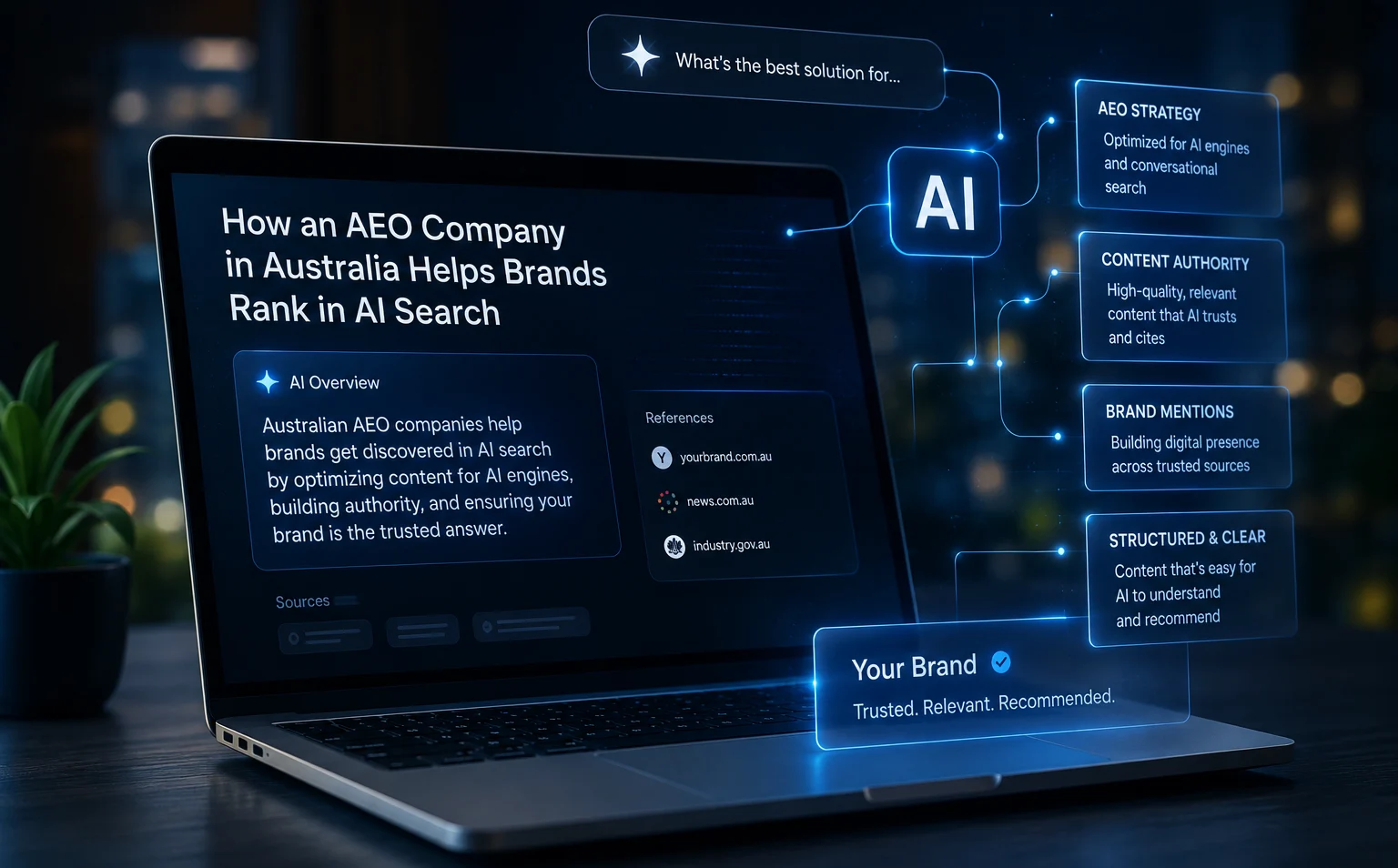
An AEO company in Australia works across several layers to position your brand for citation in AI-generated answers. Here’s what that looks like in practice.
Entity Optimisation
This is the foundation. The goal is to make your brand unmistakably recognisable to AI systems. That means ensuring your business name, services, locations, and key attributes are consistent across your website, Google Knowledge Panel, industry directories, and structured data. When AI platforms encounter your brand across multiple trusted sources and the information aligns, their confidence in citing you increases.
Answer-First Content Architecture
Traditional SEO content is often written to rank for a keyword. AEO content is written to be extracted. The difference is structural.
An AEO company restructures your key pages so that questions are addressed with clear headings and direct, concise answers in the opening lines, followed by supporting detail. This mirrors how AI systems scan and extract information. FAQ sections with proper schema markup are built around the specific questions Australian customers ask, using the natural language patterns real people use.
Structured Data Implementation
Schema markup gives AI systems a machine-readable summary of your content. FAQ schema, Product schema, LocalBusiness schema, and HowTo schema all serve specific purposes. Without them, AI platforms often struggle to interpret or simply skip your content. With them, your pages become significantly easier for these systems to process and cite.
Multi-Platform Visibility Tracking
This is where AEO services differ most obviously from traditional SEO. Instead of tracking keyword positions in Google, an AEO company monitors how and where your brand appears across ChatGPT, Google AI Overviews, Perplexity, Gemini, and Microsoft Copilot.
That means running regular retrieval tests (asking these platforms questions your target customers would ask and seeing whether your brand comes up), tracking citation frequency, and measuring how your share of mentions compares to competitors across platforms.
Authority and Citation Building
Because AI systems rely on corroboration from multiple sources, building your brand’s presence across trusted external sites is critical. This includes digital PR, co-citations in industry publications, mentions in Australian directories, and relationships with authoritative media in your sector.
Think of it like reputation building. The more credible, independent sources that reference your brand in the right context, the more likely an AI system is to include you in its answer.
Conversational Content Strategy
AI search is driven by natural-language queries. Someone in Melbourne is more likely to ask “What’s the best CRM for real estate agents in Australia?” than to type “CRM real estate Australia.” AEO services map out these conversational query patterns for your industry and ensure your content speaks to them directly, in the language your audience actually uses.
Why Local AEO Expertise Matters for Australian Brands
AEO principles are universal, but how they’re applied depends on the market. Australian search behaviour has its own patterns, seasonal rhythms (EOFY, Boxing Day, back-to-school), and regional nuances that a generic global approach won’t capture.
An AEO company in Australia brings something a global agency can’t: an understanding of how Australian consumers phrase their questions, which local directories and publications carry authority in this market, and how to optimise for city-specific and region-specific queries across Sydney, Melbourne, Brisbane, Perth, and beyond.
There’s also the relationship between AEO and traditional SEO to consider. AEO doesn’t replace SEO. Research shows that pages ranking first in Google have a 43.2% chance of also being cited by ChatGPT, compared to much lower rates for pages outside the top 20. This means strong SEO foundations support AEO performance. The best AEO services in Australia build on your existing search presence rather than starting from scratch.
Bringing It All Together
AI search is changing how customers find, evaluate, and choose brands. The shift from clicking through search results to receiving AI-generated answers means that visibility now depends on whether these systems trust and cite your business.
Getting there requires specific work: building clear entity signals, structuring content for extraction, implementing schema markup, tracking your presence across AI platforms, and earning citations from trusted sources. This is specialist work, and it’s the core of what an AEO company and experienced SEO services provider deliver.
For Australian businesses, the opportunity is real and growing. Research from Growth Memo found that the AI’s top recommendation becomes the user’s top pick 74% of the time, which means being cited early and consistently in AI answers has a direct effect on customer decisions.
The brands that build this visibility now are the ones AI systems will continue to favour as these platforms evolve.
How Savit Interactive Can Help
At Savit Interactive, we have been helping Australian businesses adapt to search evolution for over two decades. Since 2004, we’ve guided brands through every major shift, from keyword-based SEO to mobile-first indexing, and now to Answer Engine Optimisation.
As an AEO company in Australia, we work through our proprietary Savit AEO 360 framework, launched in 2025 specifically to address the AI search shift. Our AEO services in Australia cover entity optimisation, answer-first content architecture, structured data implementation (FAQ, Product, HowTo, LocalBusiness schema), multi-platform AI visibility tracking across ChatGPT, Google AI Overviews, Perplexity, and Gemini, authority signal building through Australian digital PR, and ongoing retrieval testing.
We combine this with the traditional SEO foundation that supports AEO performance, drawing on 55,000+ keywords ranked on Google’s first page and over 960,000 enquiries generated for clients across Australia and beyond.
Whether you’re a Sydney fintech brand, a Melbourne eCommerce retailer, or a Brisbane B2B services firm, we tailor every strategy to your market, your audience, and the specific AI platforms where your customers are making decisions.
Want to see how your brand appears in AI search today? Get in touch with us for a free AI visibility audit and a clear view of where the opportunity sits.